July 4th Fireworks
This July 4th, I tried some Digital Photography of Fireworks using my Canon G5 for the first time. It was definitely very good opportunity to learn how to take pictures of fireworks. First, here are some of my favorite shots.
It was overall a very satisfactory experience. Myself and a couple of other friends were all set with our cameras and tripods 1/2 an hour before the show started. The show lasted for about 40 minutes. We played around with various shutter speeds and apertures to get the best shot without letting it to shine too much. I took total 68 pictures and the 8 pasted above are the best of the bunch. They've beat all my expectations. So what did we learn ?... Here we go .
Lessons Learned - tips on how to take photographs of fireworks
I guess this is it. Hopefully New Year Eve fireworks session will be even better !
UPDATE : 8/6/2004 7:00 PM
Updated Exposure information in the images posted. Also below is a size adjusted version of "Flowers on the Fence" to give a persepctive of distance. Thanks for the suggestion "J".
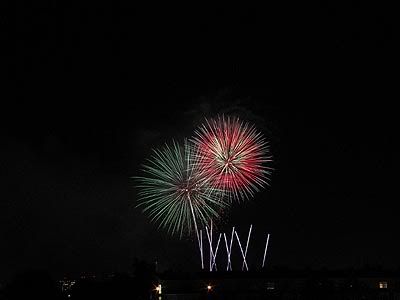
-Saanga
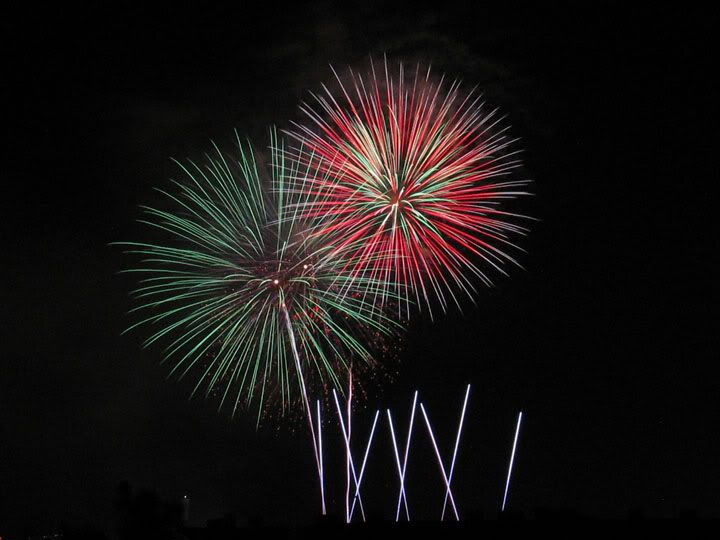 Flowers on the Fence F8.0, 8.0 sec, ISO 50 | |
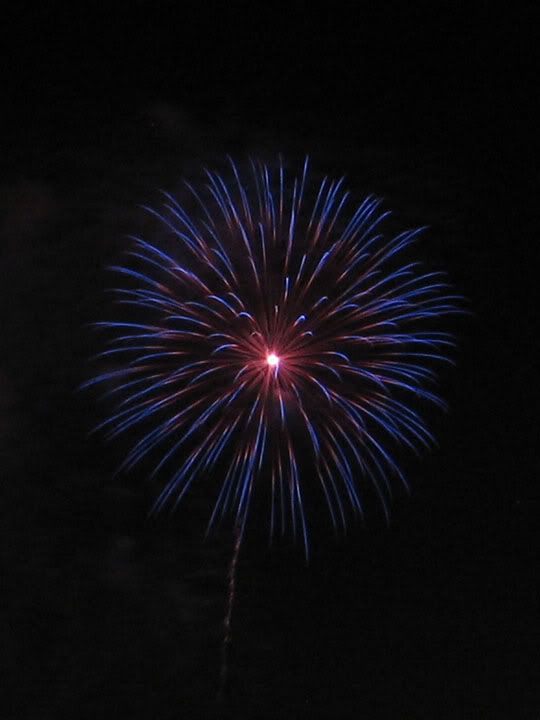 The Blue Eye F8.0, 4.0 sec, ISO 50 | 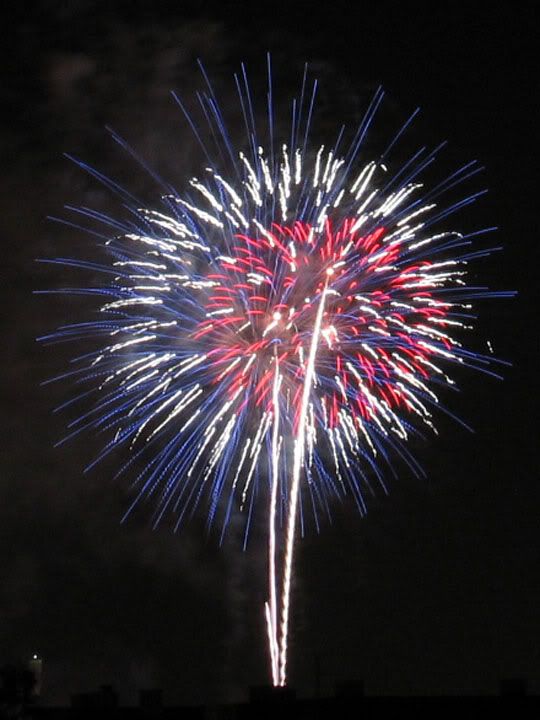 Red, White and Blue F8.0, 3.2 sec, ISO 50 |
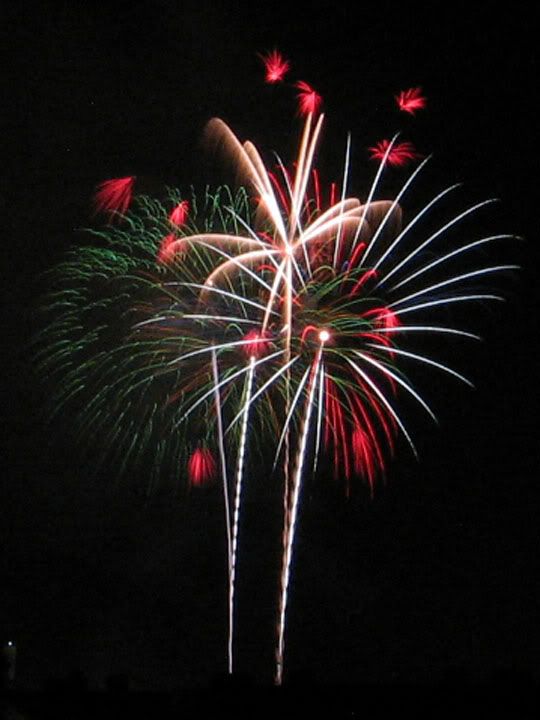 Honeybees F8.0, 15.0 sec, ISO 50 | 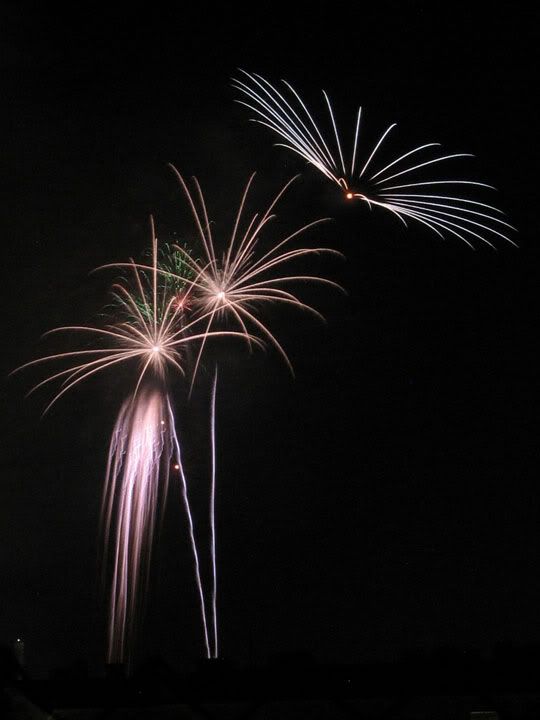 Lilies F8.0, 15.0 sec, ISO 50 |
 Rose Bouquet F8.0, 15.0 sec, ISO 50 | 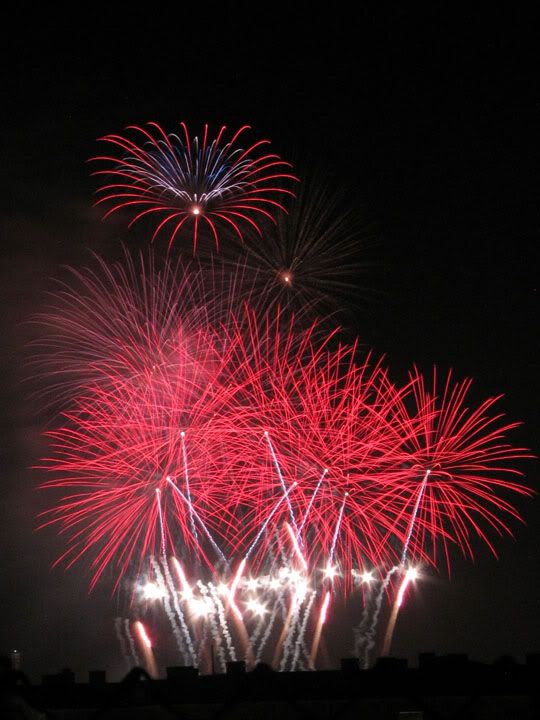 Diamonds and Roses F8.0, 15.0 sec, ISO 50 |
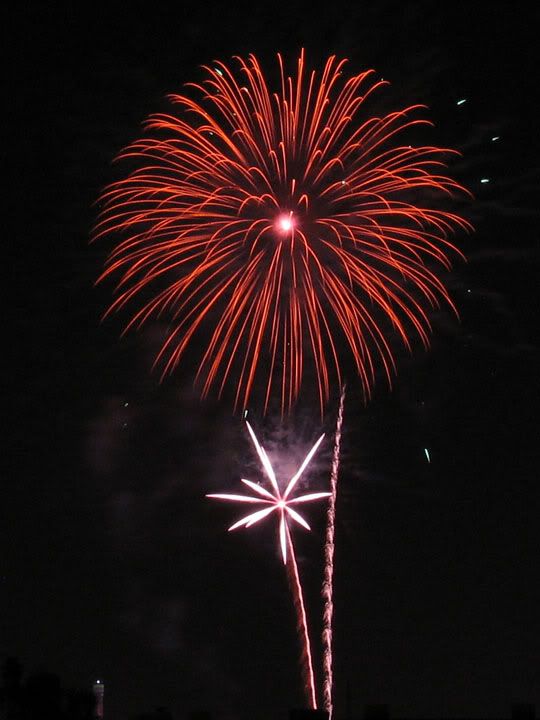 Trees on The Beach F8.0, 4.0 sec, ISO 50 | |
It was overall a very satisfactory experience. Myself and a couple of other friends were all set with our cameras and tripods 1/2 an hour before the show started. The show lasted for about 40 minutes. We played around with various shutter speeds and apertures to get the best shot without letting it to shine too much. I took total 68 pictures and the 8 pasted above are the best of the bunch. They've beat all my expectations. So what did we learn ?... Here we go .
Lessons Learned - tips on how to take photographs of fireworks
- Location, Location, Location. The location we had chosen was about a mile and half from the fireworks site. The level was excellent, with minimal obstacles in between. And the best part was, Wind was at an angle going in opposite direction. If the smoke is flowing in your direction, your pics would look like "smokeworks". Also, we hardly had to change the angle of the tripod once set. Another important thing to remember is that, make sure there are minimum other light sources in your field of view (unless it's a spectacular city skyline that would look gorgeous in the background of your fireworks !! )
- Tripod is a MUST. With long exposures (2 to 15 sec!) to capture the spectacle, Tripod is a MUST. Most of us cannot hold the camera steady for more then 1/60 second.
- Go all Manual. That's right. The best way to learn is try it out. Automated modes don't teach you anything. Here are the things I set up manually.
- Focus: Manual Focus set to infinite.
- Control Mode: Set to Manual "M" (on my Canon G5). This allows full control over Aperture and Shutter Speed. In other words, you control how much light will be applied and for how long. Camera's Metering is completely ignored.
- Aperture: Set to minimum. i.e. Maximum F number, in Canon G5 F8.0
- Shutter Speed: I tried various speeds between 2 seconds and 15 seconds. Longer exposures yield very interesting results as you can already see above.
- I even turned on ND Filter, a built in feature in Canon G5 that create a Filter effect that you'd typically use to decrease depth of field by widening aperture in bright sunny days without letting too much of light in. I just tried it because, I wanted to expose even less light, in order to make the pictures look finer, capture the colors better. But it helped in other unexpected way, it filtered out a lot of smoke!
- Focus: Manual Focus set to infinite.
- Composing the Picture I'd say don't worry too much about this. Take it for granted that you are going to have to crop the image once you download it. You can't predict where a shell is going to explode. Also if you zoom in too much, you may loose part of the explosion. Best is, zoom out to reasonable field, use maximum file size and resolution, do your framing offline by cropping. You'll have this luxury only if you have large flash memories and you are at a reasonable distance from the site.
- Releasing the Shutter You want to release the shutter without shaking the camera. Best way is to use the remote. That's what I did. But I missed couple of good opportunities while trying to point the remote correctly. So after that I started releasing the shutter by hand. This still didn't cause any problem, because the camera was firmly set in the tripod. Another reason why tripod is a must.
- Timing the Release. Lot of the otherwise excellent shots were ruined by falling debris. Although, this can create interesting effects, best pics have minimal of such debris. That's why the best time to release the shutter is right after the sky is clear and you see new shells shooting upwards. Oh and important thing, keep your finger on the release button, but your eyes on the show, not LCD . As you won't be worrying about framing, no need to look at the LCD anyway.
- "Do you have a flashlight ?" You will be asking someone else if you don't have one. And chances are that you will definitely need one if you have selected a good - dark - location, to set or check some controls of your camera. Keep a small and handy penlight with you.
- Try different shutter speeds Don't stick to a 2 or 3 second exposure, try various exposures of different lengths, you are not going to overexpose the picture anyway if u have selected a dark location, a small aperture and multiple explosions don't happen at the same spot. In Canon G5, once you select Manual mode "M", you can set both shutter and aperture with a single jog dial button!
- Don't try to get the "Finale" in a single long exposure It definitely will look like overexposed mess... Not pretty ! Instead, I could have taken it in multiple 1 second or smaller exposures.
- Take as many shots as you can Keep a lot of flash memory loaded and take a lot of pictures, you will find some very interesting shots in it.
I guess this is it. Hopefully New Year Eve fireworks session will be even better !
UPDATE : 8/6/2004 7:00 PM
Updated Exposure information in the images posted. Also below is a size adjusted version of "Flowers on the Fence" to give a persepctive of distance. Thanks for the suggestion "J".
-Saanga
Labels: Canon Powershot G5, Low Light
posted by saanga at 7/07/2004 10:31:00 PM


11 Comments:
I've enjoyed reading your blog on the G5. Please post some exposure info on the fireworks shots, and also show a couple un-croped fireworks to provide distance perspective.
Thanks
J
this is a nice canon sd400 blog
Whatever it is,* you can get it herevivitar digital camera
Great fireworks shots. I've never visualized such sceneries in fireworks. Love, the "Honeybees" shot. Excellent control of shutter timing.
Super shots with a well written "how" explanation. Thank you.
Lovely pictures, I have a Fuji 5600 but live in a dodgy area - Birmingham - so I only have one chance this year to get pics of fireworks. I used to live by the coat & would've had tons of chances but my camera was duff.
Well done, nice shots.
Nice tips.
With digital cameras it has become easier to capture fireworks (and not only them) - you can see the result and adjust everything that needs to be adjusted.
More tips and hints by FeaturePics Authors at http://www.featurepics.com/editorial/capture_great_fireworks_photos.aspx
What do you know LOTRO Gold. Do you want to have a try? You can get Lord Of The Rings Gold here. And welcome to our website, here you can play games, and you will buy LOTRO Gold to play game. Do you want a try, come and view our website, and you will learn much about cheap Lord Of The Rings Gold. Come and join with us. We are waiting for your coming.
Do you want to know the magic of online games, and here you can get more Pirates of the Burning Sea Gold. Do you want to have a try? Come on and potbs gold can make you happy.You can change a lot potbs Doubloon for play games. Playing online games can make much potbs money. And you can buy potbs Doubloon do what you want to do in the online game.
花蓮|花蓮民宿|花蓮|花蓮民宿訂房諮詢服務|花蓮民宿|花蓮旅遊|花蓮民宿|花蓮美食|花蓮旅遊|花蓮黃頁 網路電話簿|花蓮民宿|花蓮入口網 IN HUALIEN 吃喝玩樂樣樣通|花蓮民宿黃頁|花蓮美食|花蓮飯店|花蓮住宿|花蓮民宿|花蓮民宿|花蓮|花蓮|花蓮民宿|花蓮民宿訂房|花蓮旅遊|http://www.hl998.com.tw|花蓮旅館|花蓮|花蓮民宿黃頁|花蓮民宿推薦|花蓮民宿王|花蓮民宿網|花蓮民宿資訊網|花蓮民宿悠遊網|花蓮|花蓮海景民宿|花蓮海邊民宿|花蓮海岸民宿|花蓮旅遊民宿|花蓮旅遊民宿|花蓮旅遊景點|花蓮廣告|花蓮民宿|花蓮房屋|花蓮汽車旅館|花蓮派報|花蓮飯店|花蓮派報|花蓮旅館|花蓮美食|花蓮餐廳|花蓮小吃|花蓮名產|花蓮工作|花蓮新聞|花蓮租車|花蓮入口網|花蓮旅遊|花蓮旅遊|花蓮旅遊景點|花蓮旅遊|花蓮旅遊景點|花蓮民宿|花蓮房仲|花蓮旅遊景點|花蓮美食黃頁|花蓮餐廳|花蓮小吃|花蓮名產|花蓮租車旅遊資訊網|花蓮民宿|花蓮|花蓮民宿|花蓮旅遊|花蓮民宿|花蓮美食|花蓮旅遊|花蓮租車|花蓮旅遊|花蓮民宿訂房花蓮|花蓮民宿|花蓮民宿|花蓮美食推薦|花蓮旅遊資訊|花蓮|花蓮電影|花蓮房屋|花蓮美食地圖|花蓮汽車|花蓮地圖|花蓮海洋公園|花蓮遠雄悅來飯店|花蓮瑞穗牧場|花蓮民宿訂房諮詢服務|花蓮旅館|花蓮提拉米蘇|花蓮旅遊景點|花蓮太魯閣|花蓮就業|花蓮理想大地|花蓮|花蓮|花蓮|花蓮|花蓮|花蓮|花蓮|花蓮|花蓮|花蓮|花蓮|花蓮|花蓮|花蓮|花蓮|花蓮|花蓮
花蓮租車網提供您專業的花蓮旅遊諮詢及優質的花蓮租車服務,無論是【花蓮租車、行程規劃、代訂住宿】等,均能滿足您的需求。
市區、車站、機場免費接送 訂車專線:03-8221988 免費行程規劃
§ 凡事先完成預約手續者均可享特價再九折優惠(租多台、多天另有優惠)§
◆花蓮租車半日遊:
行程時間4小時,五人座房車2000元;八人座休旅車2500元;廿十一人座中巴5000元。 (含車資,司機薪水,油錢,乘客險)
行程內容4選1:
A.花東縱谷半日遊 B.太魯閣半日遊 C.慕谷慕魚半日遊 D.東海岸半日遊
◆花蓮租車 一日遊:
行程時間8小時,五人座房車2800元;八人座休旅車3500元;廿十一人座中巴7000元。 (含車資,司機薪水,油錢,乘客險)
行程內容3選1
A.天祥太魯閣一日遊 B.花東縱谷風情一日遊 C.花東海岸一日遊
花蓮租車網(連結):
http://www.hualientour.com
ralph lauren poloburberry polo shirtthe north face jacketcolumbia jacketspyder jacketed hardy clothing ed hardy clothesed hardy shirts ed hardy t-shirts ed hardy sunglasses ed hardy mensed hardy womens Wholesale HandbagsCheap HandbagsWomens HandbagsCheap PursesDesigner HandbagsTennis RacquetTennis Racket
cheap tennis racquet
tennis racquet discount
cheap tennis racket
discount Tennis Rackethead junior tennis racketwilson tennis racquet
wilson tennis racket
head tennis racketbabolat tennis racket
Post a Comment
<< Latest